
.png)


Start your Journey Today
Schedule a free consultant to discuss your career goals
Oops! Something went wrong while submitting the form.



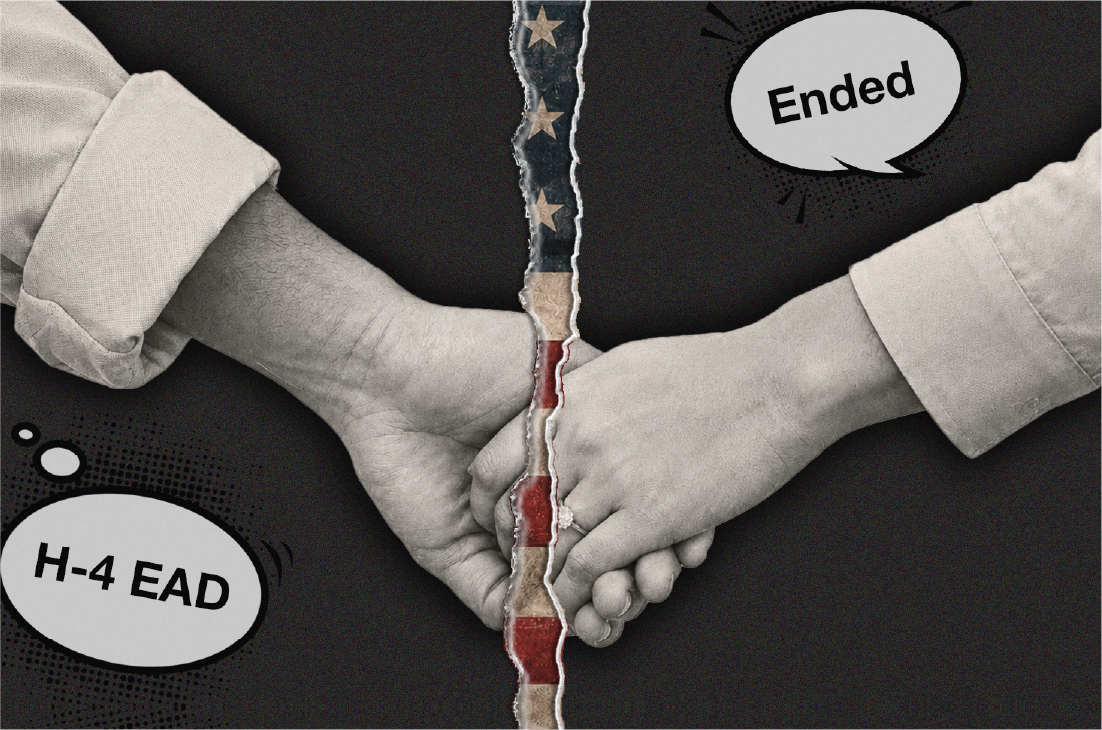
A proposed DHS rule could end employment authorization for certain H-4 spouses. Here's why the Trump administration is targeting the program, who could be affected, and what H-4 families should know right now.
For some H-1B families, there are two careers in the United States.
One belongs to the H-1B worker.
The other belongs to their spouse.
For more than a decade, certain H-4 spouses have been able to build that second career legally through an H-4 Employment Authorization Document (EAD).
Now, that could change.
The Trump administration is moving toward reversing the policy that allows eligible H-4 dependent spouses of H-1B workers to obtain employment authorization. DHS has listed a proposed rule titled “RemovingH-4 Dependent Spouses From the Classes of Noncitizens Eligible for Employment Authorization.”
But there is an important distinction before we go any further:
H-4 EAD work authorization has not been cancelled today.
The proposal is still at the regulatory stage. There is currently no announced effective date, and existing H-4 EAD holders can continue working under the current rules.
So why is this happening?
And why are H-4 spouses suddenly at the center of the U.S.immigration debate?
An H-4 visa is a dependent visa generally used by spouses and children of H-1B workers.
The H-4 visa itself is not a work visa.
That distinction matters.
For certain H-4 spouses, the ability to work comes through a separate Employment Authorization Document, commonly called an H-4 EAD.
The H-4 EAD program was introduced in 2015. It allowed certain spouses of H-1B workers who met specific eligibility conditions generally connected to their spouse's employment-based green-card process to apply for work authorization.
That changed life for many families.
An H-4 spouse could become a software engineer, analyst,teacher, healthcare professional, researcher, or entrepreneur instead of beinglimited to dependent status without employment authorization.
For many households, it also meant something practical:
two incomes instead of one.
The proposed change is part of a broader Trump administration effort to reconsider how employment-based immigration operates in the United States.
DHS's regulatory agenda specifically says the proposal would reverse the 2015 rule and restore the department's earlier position of not extending employment-authorization eligibility to H-4 dependent spouses.
The policy debate is essentially built around a bigger question:
Should employment opportunities created through the U.S.immigration system be reserved more narrowly for the principal visa holder,rather than extending work authorization to dependents?
Supporters of restricting H-4 employment argue that limiting work authorization could reduce competition for American workers and narrow employment-based immigration.
But opponents see a very different problem.
They argue that H-4 spouses are often highly educated professionals themselves. Removing their ability to work could make it harder for U.S. companies to recruit and retain H-1B talent because the decision to move to America is often a family decision, not an individual one.
That is an important part of this story.
An H-1B worker doesn't move to the United States alone.
They may move with a spouse.
And a spouse's ability to build a career can influence whether the family chooses to stay.
The proposed rule applies to eligible H-4 spouses generally,regardless of nationality or background.
Many H-4 spouses are professionals with their own degrees,careers and long-term goals.
For an H-1B family, the potential change could look like this:
One spouse continues working on H-1B.
The other may have to stop working if their employment authorization eventually expires and they no longer qualify under a new rule.
That can affect far more than a paycheck.
It can affect career progression, professional identity,household finances and long-term plans in the U.S.
No.
This is probably the most important point to understand.
The DHS action currently being discussed is a proposal.
It does not itself cancel existing H-4 EADs.
It does not immediately make H-4 spouses unauthorized to work.
It does not mean employers need to terminate H-4 EAD employees today.
The regulatory agenda entry says DHS intends to pursue a Notice of Proposed Rulemaking, but no publication date has been announced.
Until a final rule changes the law and becomes effective,the existing H-4 EAD framework remains in place.
So if you currently hold a valid H-4 EAD, don't make employment decisions based solely on headlines.
This is where things could become complicated.
If DHS finalizes the proposal, eligible H-4 spouses could lose the regulatory basis to request employment authorization under the (c)(26) category.
But the exact treatment of:
would depend on the language of the final rule.
And that language does not yet exist.
This is why claims such as “all H-4 spouses will lose their jobs next month” go further than the current official information supports.
The proposal is serious.
But the outcome is not final.
Potentially, yes.
For an H-1B family, employment authorization for the spouse can influence the family's overall financial stability.
Imagine a house hold that has planned its rent, mortgage, child care, savings and long-term goals around two incomes.
If one spouse suddenly loses the ability to work, the financial impact could be substantial.
There is also a professional cost.
A person who has spent years building experience in the U.S.workforce could face a forced career interruption.
For employers, that could mean losing skilled workers who are already familiar with the U.S. workplace.
This is why the debate around H-4 EAD isn't simply about awork permit.
It is also about family stability and talent retention.
The best response is not panic.
It's preparation.
If you're currently working on an H-4 EAD:
Keep working under your current valid authorization.
Keep track of your EAD expiration date and immigration documents.
Don't stop employment because of an announcement that hasn't taken effect.
And don't assume the final rule will automatically look exactly like the proposal.
Most importantly, if your family's immigration situation is complicated or your employment authorization is approaching expiration, speak with a qualified U.S. immigration attorney who can assess your individual circumstances.
There may also be other immigration pathways depending on your situation, but those options are highly case-specific.
That's what makes the H-4 EAD debate different from many other immigration updates.
The person affected isn't necessarily the person whose visa started the immigration journey.
The H-1B worker may be the principal visa holder.
But the spouse may have built a career, earned a salary,developed professional relationships and created a life in the United States.
Take away the ability to work, and the impact doesn't stop at the workplace.
It reaches the household.
That's why H-1B families should pay attention but not panic before there is a final rule.
For now, the message is simple:
The H-4 EAD program is under threat, not gone.
The next important step will be the publication of DHS's proposed rule, followed by the public-comment and final-rule process.
Until then, stay informed, keep your documents current, and make decisions based on the rule that is actually in effect not the headline circulating online.
Immigration policies can change.
Your career shouldn't have to stop every time they do.
At NetBounce Placement, we help international professionals and students understand the U.S. job market, prepare for interviews, strengthen their resumes and pursue career opportunities across the United States.
If you're on H-4 EAD, H-1B, F-1, OPT or STEM OPT,your immigration status is one part of your journey.
Your skills, experience and career strategy are the parts you can continue building today.
Stay informed about the rules. Keep building what is in your control.
Because when the policy changes, the strongest position tobe in is having options.