Start your Journey Today
Schedule a free consultant to discuss your career goals
Oops! Something went wrong while submitting the form.


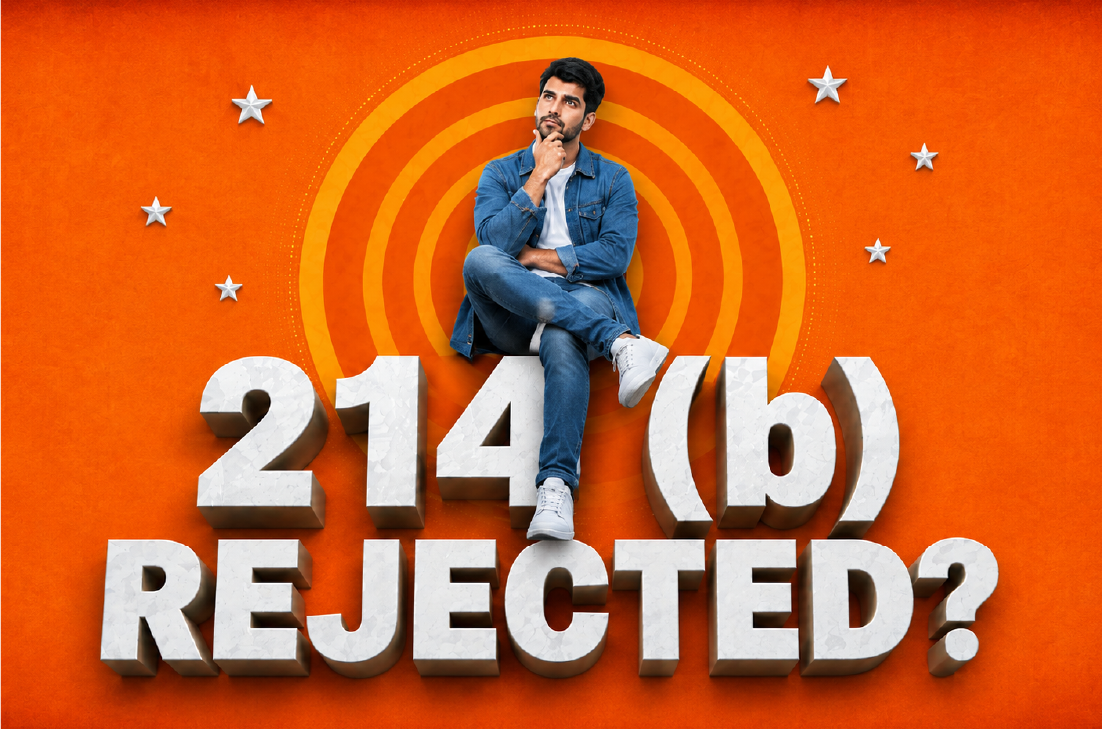
An F-1 visa interview isn't always a long conversation. Sometimes it ends in under a minute. If you've ever wondered why a U.S. student visa gets rejected after just a few questions, this article explains what really happens and what every international student should understand before stepping up to the interview window.
That's all it took.
Two questions.
A quick glance at the computer screen.
A few seconds of typing.
Then came the sentence no international student wants to hear.
"I'm sorry. Your visa cannot be approved today."
No questions about the university.
No discussion about future plans.
No opportunity to explain years of preparation, academic achievements, or career goals.
Just a 214(b) refusal slip.
At first, it feels unfair.
"How can someone decide my future without even listening to me?"
It's one of the most common emotions students share after an F-1 visa rejection.
But here's something that many applicants don't realise.
Sometimes, the interview isn't where the decision begins.
It's where the officer confirms a decision that's already taking shape.
Most students prepare for an interview as though it's acollege admission viva.
They memorize answers.
They rehearse why they chose their university.
They practice explaining why they want to study in the USA.
Some even prepare answers to fifty or sixty possible questions.
Preparation is important.
But many applicants unknowingly prepare for the wrong part of the process.
A U.S. student visa interview isn't designed to hear your entire story.
It's designed to help the visa officer determine whether your application meets the legal requirements for an F-1 visa.
By the time you step up to the interview counter, the officer has already reviewed key parts of your application.
Your DS-160, your university, your academic background, previous travel history, and other information have already started telling your story.
The interview often exists to verify that story not to build it from scratch.
This is probably the question that brings most students to Google.
"Why was my F-1 visa rejected after only two questions?"
The truth is, there isn't one universal answer.
A short interview doesn't automatically mean you made a mistake.
It doesn't always mean your university is weak.
It doesn't mean the officer was having a bad day.
And it certainly doesn't mean that speaking for longer would have changed the outcome.
Every F-1 visa application is assessed individually.
Sometimes the officer needs several questions before reaching a decision.
Sometimes they only need one clarification.
And sometimes the information already available is enough for them to make a decision without a lengthy conversation.
That's why comparing your interview with someone else's rarely helps.
No two applications are exactly alike.
Many students leave the embassy disappointed because they never got the chance to explain themselves.
But here's another way to look at it.
The questions that weren't asked can be just as important as the ones that were.
If the visa officer doesn't ask about your funding, it doesn't necessarily mean they ignored it.
If they don't ask why you chose your university, it doesn't mean they weren't interested.
It often means they had already reviewed those details before the interview even began.
This is why the quality of your application matters just as much as the quality of your answers.
One of the biggest mistakes applicants make is believing the interview begins when their name is called.
In reality, it starts much earlier.
It begins when you fill out your DS-160.
It continues with every document you submit.
Every detail should support the same story.
Your academic journey should make sense.
Your study plans should be logical.
Your financial documents should align with your application.
Your answers should naturally match the information you've already provided.
When everything fits together, you're not trying to convince the officer.
You're simply confirming what's already there.
This is another difficult truth.
In many cases, No.
A 214(b) refusal simply means the visa officer wasn't convinced that the applicant qualified for an F-1 visa under the requirements of U.S. immigration law on that particular day.
It doesn't always point to one specific mistake.
That's why relying on social media comments like "You should have answered this differently" or "You smiled too much" can be misleading.
Nobody outside the interview window knows exactly what influenced the decision.
Instead of trying to copy someone else's interview answers, spend time understanding your own application.
That's where meaningful preparation begins.
A rejection is disappointing.
But it doesn't always mean the end of your journey.
Before booking another interview, take a step back.
Review your application honestly.
Ask yourself:
Reapplying without understanding what may have weakened your application often leads to the same result.
Improving your profile is always more valuable than simply repeating the interview.
Many students believe they were rejected because they didn't get enough time to explain themselves.
Maybe.
Maybe not.
The more important question is this:
Did your application already tell a clear and believable story before you even spoke?
Because that's what an F-1 visa interview is ultimately testing.
Not your ability to deliver a perfect speech.
But the consistency between your documents, your intentions, and your answers.
Every year, thousands of international students receive an F-1visa approval after carefully strengthening their profile and preparing the right way.
A short interview doesn't define your potential.
A refusal doesn't erase your academic achievements.
And one difficult day at the embassy doesn't decide your entire career.
What matters is what you do next.
Learn from the experience.
Improve what you can control.
Then return with a stronger application not just stronger answers.
At Netbounce Placement, we've worked with students who walked into interviews feeling confident, students who faced visa refusals, and students who eventually achieved their dream of studying and working in the United States.
The biggest lesson we've learned is simple:
Your interview doesn't start when the visa officer asks the first question.
It starts with every decision you make long before you stand at that counter.
Prepare your profile.
Understand your story.
And when your moment comes, let your application speak as confidently as you do.